


News Release 11-207
President Obama Names Top U.S. Early Career Scientists and Engineers
Twenty-one NSF-funded, NSF-nominated researchers are among the 94 scientists and engineers to receive the Administration's highest honor for early career research and outreach
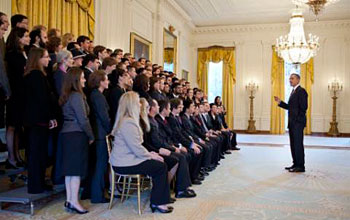
President Barack Obama greets the 2010 PECASE recipients in the East Room of the White House.
October 17, 2011
This material is available primarily for archival purposes. Telephone numbers or other contact information may be out of date; please see current contact information at media contacts.
On Friday at the White House, President Barack Obama honored 94 women and men with the United States government's highest honor for scientists and engineers in the early stages of their independent research careers--the Presidential Early Career Award for Scientists and Engineers (PECASE).
The National Science Foundation (NSF) nominated 21 of the awardees, who come from universities around the country and excel in research in a variety of scientific disciplines: biological sciences; computer and information science and engineering; education and human resources; engineering; geosciences; mathematical and physical sciences; and social, behavioral and economic sciences.
The PECASE awards embody the high priority the Administration places on producing outstanding scientists and engineers to advance the nation's goals and contribute to all sectors of the economy.
"It is inspiring to see the innovative work being done by these scientists and engineers as they ramp up their careers--careers that I know will be not only personally rewarding but also invaluable to the nation," Obama said when the awards were announced in September. "That so many of them are also devoting time to mentoring and other forms of community service speaks volumes about their potential for leadership, not only as scientists but as model citizens.
"The awards, established by President Clinton in February 1996, are coordinated by the Office of Science and Technology Policy within the Executive Office of the President. Awardees are selected on the basis of two criteria: pursuit of innovative research at the frontiers of science and technology and a commitment to community service as demonstrated through scientific leadership, public education or community outreach.
The 2010 NSF-nominated awardees are:
Katherine E. Aidala, Mount Holyoke College
For her ambitious studies aimed at understanding critical charge transport mechanisms in nanocrystal quantum dot materials, and for her comprehensive education and mentoring activities for female undergraduate students.
Hatice Altug, Boston University
For advancing the frontiers of proteomics to enable the discovery of protein bio-markers for detection of disease, drugs and environmental monitoring, and for innovative educational and outreach activities that have helped students at all levels.
Amir S. Avestimehr, Cornell University
For pushing the frontiers of information theory through its extension to complex wireless information networks and extensive outreach to underrepresented groups.
Joshua C. Bongard, University of Vermont
For innovative research in evolutionary robotics and work on robots that can learn adaptive behaviors, and for active promotion of student engagement through robotics experiments.
David J. Brumley, Carnegie Mellon University
For innovative and vital research on malware analysis and for strong educational and outreach activities.
Elizabeth S. Cochran, U.S. Geological Survey
For developing a novel sensor technique to explore earthquake rupture processes and for engaging citizen scientists, through K-12 and public outreach in Southern California.
Noah J. Cowan, Johns Hopkins University
For innovative research in biologically inspired robotic systems with application to disaster recovery and space exploration and for motivating students to explore careers in science and engineering.
Xiangfeng Duan, University of California, Los Angeles
For demonstrating a commanding awareness of multiple areas of nanoscience and nanotechnology and for the creation of a novel and potentially very significant new class of carbon-based nanostructures.
Michael J. Escuti, North Carolina State University
For pioneering research in innovative liquid-crystal polarization gratings and strong dedication to the education of students through collaborations with international academic teams and industries, and for active outreach in underserved communities.
Demetra C. Evangelou, Purdue University
For outstanding research into how early experiences can lead children to pursue engineering later in life and for working with teachers from diverse schools to develop new teaching materials and methods that can help students become innovative and more technologically literate.
Benjamin A. Garcia, Princeton University
For innovative approaches to discovering how chemical modifications on nuclear histone proteins can control gene activity during growth and development, and for outstanding outreach to underserved students and educators at community colleges.
Tina A. Grotzer, Harvard Graduate School of Education
For innovative research on how children can learn to reason about complex causality and for inclusion of teachers, undergraduates and graduate students in research and development activities.
Lasse Jensen, Pennsylvania State University
For addressing fundamental questions relevant to optical spectroscopy of bio- and nano-systems and for exemplary teaching efforts and the dissemination of computational tools to the chemistry community.
Benjamin Kerr, University of Washington
For studies of pathogen-host co-evolution as a function of transmission through contact networks and for strong dedication to teaching and mentoring, especially the devlopment of innovative curriculum materials and outreach to students in underrepresented groups.
Benjamin L. Lev, Stanford University
For studying exotic forms of matter by manipulating the quantum states of dipolar atoms--in the course of which the first ultracold gas of dysprosium was trapped--and for outreach activities that brought atomic and molecular physics to undergradutes, high school students, and teachers.
Elena G. Litchman, Michigan State University
For integration of theoretical and experimental studies to predict how global environmental change modifies physical processes and phytoplankton diversity and evolution within lakes, and for interdisciplinary training and outreach to K-12 teachers.
Yasamin C. Mostofi, University of New Mexico
For groundbreaking research on compressive-sampling-enabled mobile sensor networks, and for dedicated educational activities involving both high school and community college students in robotics, with a particular emphasis on motivating Native American students to pursue engineering careers.
Lilianne R. Mujica-Parodi, State University of New York at Stony Brook
For outstanding research in the application of complex systems analysis to neurodiagnostics of mental and neurological illness, and for development of a K-12 curriculum in control systems modeling.
Andre D. Taylor, Yale University
For outstanding research on sustainable biofuel technologies, and for educational and outreach activities that inspire high school and university students, including students from underrepresented groups, to pursue careers in sustainable energy.
Claudia R. Valeggia, University of Pennsylvania
For work on somatic, developmental, cultural and endocrine correlates of key life history transitions, and for developing educational programs for indigenous people, promoting student training, and aiding hospitals to help determine infant feeding choices.
Maria G. Westdickenberg, Georgia Institute of Technology
For excellent research in applied mathematics, and leadership in recruiting, training, and mentoring students from underrepresented groups.
-NSF-
Media Contacts
Matthew Shipman, North Carolina State University, (919) 515-6386
Lisa-Joy Zgorski, NSF, (703) 292-8311, email: lisajoy@nsf.gov
E.K. Gardner, Purdue University, email: ekgardner@purdue.edu
Michael Seele, Boston University, (617) 353-9766, email: mseele@bu.edu
Stuart Wolpert, UCLA, (210) 206-0511, email: swolpert@support.ucla.edu
Robin Hogan, Yale University, (203) 432-5423, email: robin.hogen@yale.edu
Dan Stober, Stanford University, (650) 721-6965, email: dstober@stanford.edu
Karen Wentworth, University of New Mexico, (505) 277-, email: kwent2@unm.edu
Claudia Wheatley, Cornell University, (607) 255-6074, email: caw43@cornell.edu
Cass Cliatt, Princeton University, (609) 258-6108, email: ccliatt@princeton.edu
Clarice Ransom, U.S. Geological Survey, (703) 648-4299, email: cransom@usgs.gov
Joshua Brown, University of Vermont, (802) 656-3039, email: joshua.e.brown@uvm.edu
Mary Jo Curtis, Mount Holyoke College, (413) 538-2030, email: mjcurtis@mtholyoke.edu
Barbara Kennedy, Pennsylvania State University, (814) 863-4682, email: science@psu.edu
Evan Lerner Lerner, University of Pennsylvania, (215) 573-6604, email: elerner@upenn.edu
Layne Cameron, Michigan State University, (517) 353-8819, email: layne.cameron@ur.msu.edu
Vince Stricherz, University of Washington, (206) 543-2580, email: vinces@u.washington.edu
Christine Swaney, Carnegie Mellon University, (412) 268-5776, email: swaney@andrew.cmu.edu
David Terraso, Georgia Institute of Technology, (404) 385-1393, email: david.terraso@cos.gatech.edu
Greg Filiano, State University of New York, Stony Brook, (631) 444-7880, email: gfiliano@notes.cc.sunysb.edu
Jill Anderson, Harvard University Graduate School of Education, (617) 496-1884, email: jill_anderson@gse.harvard.edu
Program Contacts
Mayra N. Montrose, NSF, (703) 292-4757, email: mmontros@nsf.gov
Related Websites
White House release on PECASE Awards: http://www.whitehouse.gov/the-press-office/2011/09/26/president-obama-honors-outstanding-early-career-scientists
Questions and answers about PECASE and CAREER Awards: http://www.nsf.gov/news/news_summ.jsp?cntn_id=111927
Mount Holyoke College release on Katherine Aidala: http://www.mtholyoke.edu/news/channels/25/stories/5683140
The University of Vermont's press release on Joshua Bongard: http://www.uvm.edu/~uvmpr/?Page=news&storyID=12435
UC Riverside's release on Elizabeth Cochran: http://newsroom.ucr.edu/2744
UCLA's release on Xiangfeng Duan: http://newsroom.ucla.edu/portal/ucla/3-outstanding-ucla-scientists-216221.aspx
Penn State release on Lasse Jensen: http://science.psu.edu/news-and-events/2011-news/Jensen9-2011/
Michigan State release on Elena Litchman: http://news.msu.edu/story/9810/
The U.S. National Science Foundation propels the nation forward by advancing fundamental research in all fields of science and engineering. NSF supports research and people by providing facilities, instruments and funding to support their ingenuity and sustain the U.S. as a global leader in research and innovation. With a fiscal year 2023 budget of $9.5 billion, NSF funds reach all 50 states through grants to nearly 2,000 colleges, universities and institutions. Each year, NSF receives more than 40,000 competitive proposals and makes about 11,000 new awards. Those awards include support for cooperative research with industry, Arctic and Antarctic research and operations, and U.S. participation in international scientific efforts.

Connect with us online
NSF website: nsf.gov
NSF News: nsf.gov/news
For News Media: nsf.gov/news/newsroom
Statistics: nsf.gov/statistics/
Awards database: nsf.gov/awardsearch/
Follow us on social
Twitter: twitter.com/NSF
Facebook: facebook.com/US.NSF
Instagram: instagram.com/nsfgov