



News Release 10-031
NSF Builds Science and Engineering Capacity in Communities Around the United States
Funding awarded for the creation of five Science Technology Centers
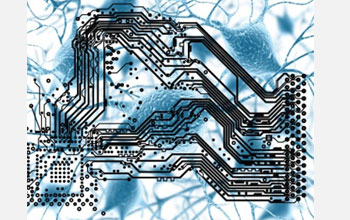
A conceptual rendering of a biological machine showing circuitry on a biological material background
February 22, 2010
This material is available primarily for archival purposes. Telephone numbers or other contact information may be out of date; please see current contact information at media contacts.
The National Science Foundation (NSF) announced five new Science and Technology Center (STC) awards as a result of a recent, merit-based competition. The STC program supports integrative partnerships that require large-scale, long-term funding to produce research and education of the highest quality. In October of 2008, NSF received 247 preliminary proposals. Following extensive panel review, 45 full proposals were invited and reviewed by both panel and ad hoc experts, 11 sites were visited, and 5 were recommended for awards by a Blue Ribbon panel. Well over 100 program directors from throughout NSF assisted in the review process. "These five new STCs will involve world class teams of researchers and educators, integrate learning and discovery in innovative ways, tackle complex problems that require the long-term support afforded by this program, and lead to the development of new technologies with significant impact well into the future," said NSF Director Arden L. Bement.
Brief descriptions of the new STCs follow:
Center for Dark Energy Biosphere Investigations (C-DEBI)
Katrina J. Edwards from the University of Southern California in partnership with faculty members at the University of Alaska-Fairbanks, University of California (UC)-Santa Cruz, University of Hawaii, Pacific Northwest National Lab, University of Rhode Island, Lawrence Berkeley National Laboratory, Japan Agency for Marine Earth Science & Technology, Harvard University and the University of Bremen will establish a center to facilitate exploration of the Earth's "deep biosphere" beneath the oceans. Although nearly half of the total biomass on Earth resides in sub-surface habitats such as mines, aquifers, soils on the continents and sediments and rocks below the ocean floor, little is known about these sub-surface communities. C-DEBI will explore such fundamental questions as: What type of life exists in the deep biosphere? What are the physical and chemical conditions that promote or limit life? How does this biosphere influence global energy and material cycles such as the carbon cycle? A number of educational and outreach activities such as "science at sea" will inspire students and the public.
BEACON: An NSF Center for the Study of Evolution in Action
Erik D. Goodman from Michigan State University in partnership with colleagues at the University of Texas-Austin, University of Washington, North Carolina A&T State University, and the University of Idaho will establish a center that will promote the transfer of discoveries from biology into computer science and engineering design, and use novel computational methods to address complex biological questions that are difficult or impossible to study using natural organisms. BEACON will bring together scientists who, through research in their own disciplines, hold the interlocking keys to solving complex and fundamental problems in domains as diverse as cyber-security, epidemiology, and environmental sustainability. BEACON education and human resource development plans include K-12 programs, novel curricula development, undergraduate and graduate training, a mentoring program for faculty and post-docs, and outreach programs to educate the general public.
Emergent Behaviors of Integrated Cellular Systems
Roger D. Kamm from the Massachusetts Institute of Technology (MIT) in partnership with researchers at the University of Illinois at Urbana-Champaign (UIUC) and Georgia Institute of Technology will establish a center to develop the science and technology to engineer clusters of living cells or "biological machines" that have desired functionalities and can perform prescribed tasks. This research will help to establish the nascent field of engineering biological systems. The center will develop programs aimed at attracting students to STEM (science, technology, engineering, mathematics) fields, and particularly to the growing area of bioengineering. An integrated inter-institutional graduate program will be developed and courses will be made accessible via OpenCourseWare.
Emerging Frontiers of Science of Information
Wojciech Szpankowski from Purdue University in partnership with colleagues at Bryn Mawr College, Howard University, MIT, Princeton, Stanford, UC Berkeley, UC San Diego, and UIUC will establish a Center for the Science of information that has the potential to launch the next information revolution. These researchers will develop a unifying set of principles to guide the extraction, manipulation, and exchange of information integrating elements of space, time, structure, semantics & context. The center will bring together researchers from diverse fields (physics, life science, chemistry, computer science, economics, etc.) to develop models and methods to apply to these diverse applications. The center will also build an active community of scholars through education and mentoring activities.
Center for Energy Efficient Electronics Science (E3S)
Eli Yablonovitch from University of California Berkeley in partnership with faculty members at MIT, Stanford, Contra Costa College, Los Angeles Trade Technical College and the Tuskegee Institute, proposed a center that will take on the challenge of increasing the energy efficiency of electronic information-processing equipment. Recent years have seen a dramatic increase in the share of electricity usage from electronics, and the trend is expected to continue unless fundamental changes are made to the power requirements of the basic logic switch. E3S will research concepts and scientific principles that could enable a few millivolt electronic switch as a successor to the transistor, laying the foundation for a million-fold reduction in power consumption by electronics. The center will also support a number of educational programs and promote energy awareness through outreach activities.
-NSF-
-
Katrina Edwards, professor of biological sciences and Earth sciences at USC, to lead an STC team
Credit and Larger Version -
BEACON scientists will study E. coli cultures and populations of self-replicating digital organisms
Credit and Larger Version
Media Contacts
Lisa-Joy Zgorski, NSF, (703) 292-8311, email: lisajoy@nsf.gov
Chad Galts, MIT, email: galts@MIT.EDU
Carl Marziali, USC, 213-740-4751, email: marziali@usc.edu
Sarah Yang, UC Berkeley, 510-643-7741, email: scyang@berkeley.edu
Elizabeth Gardner, Purdue University, 765/494-2081, email: ekgardner@purdue.edu
Laura Seeley, Michigan State University, 517-432-1303, email: lseeley@egr.msu.edu
Program Contacts
Joan M. Frye, NSF, (703) 292-8040, email: jfrye@nsf.gov
Related Websites
NSF awards $24.5 million for center to stem increase of electronics power draw: http://news.berkeley.edu/2010/02/23/nsf_award/
With $25 million grant, NSF funds center to investigate the creation of biological machines: http://web.mit.edu/newsoffice/2010/001897654-nsf-grant
MSU awarded $25 million for NSF center to study evolution in action: http://news.msu.edu/story/7459/
Purdue awarded $25 million for first NSF science and technology center in the state: http://bit.ly/1SLrSjC
USC Awarded $25 Million NSF Grant for New Center to Study the Deep Biosphere: http://college.usc.edu/news/stories/692/usc-awarded-25-million-nsf-grant-for-new-center-to-study-the-dee/
Georgia Tech to participate in project to develop biological machines: http://gtresearchnews.gatech.edu/biological-machines/
Illinois EBICS to participate in development of biological machines: http://engineering.illinois.edu/news/2010/02/18/illinois-a-partner-new-nsf-center-investigate-creation-biological-machines
NSF's Celebration of Five Leading Science and Technology Centers: http://www.nsf.gov/news/news_summ.jsp?cntn_id=116332&org=OLPA&from=news
Science Technology Centers: http://www.nsf.gov/od/oia/programs/stc/
Office of Integrated Activities: http://www.nsf.gov/dir/index.jsp?org=OIA
The U.S. National Science Foundation propels the nation forward by advancing fundamental research in all fields of science and engineering. NSF supports research and people by providing facilities, instruments and funding to support their ingenuity and sustain the U.S. as a global leader in research and innovation. With a fiscal year 2023 budget of $9.5 billion, NSF funds reach all 50 states through grants to nearly 2,000 colleges, universities and institutions. Each year, NSF receives more than 40,000 competitive proposals and makes about 11,000 new awards. Those awards include support for cooperative research with industry, Arctic and Antarctic research and operations, and U.S. participation in international scientific efforts.

Connect with us online
NSF website: nsf.gov
NSF News: nsf.gov/news
For News Media: nsf.gov/news/newsroom
Statistics: nsf.gov/statistics/
Awards database: nsf.gov/awardsearch/
Follow us on social
Twitter: twitter.com/NSF
Facebook: facebook.com/US.NSF
Instagram: instagram.com/nsfgov