




All Images
News Release 10-143
Discovery of Possible Earliest Animal Life Pushes Back Fossil Record
Primitive sponge-like creatures lived in ocean reefs 650 million years ago
This material is available primarily for archival purposes. Telephone numbers or other contact information may be out of date; please see current contact information at media contacts.
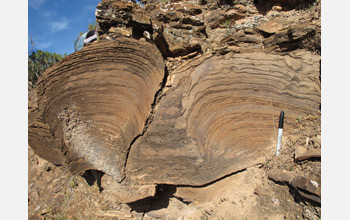
Stromatolite column of bacterial mats in Australia; sponge fossils are between stromatolites.
Credit: Adam Maloof
Download the high-resolution JPG version of the image. (4.6 MB)
Use your mouse to right-click (Mac users may need to Ctrl-click) the link above and choose the option that will save the file or target to your computer.
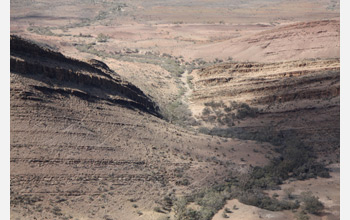
Looking east from a low-flying plane over the Little Bunkers Ranges in South Australia.
Credit: Catherine Rose
Download the high-resolution JPG version of the image. (4.7 MB)
Use your mouse to right-click (Mac users may need to Ctrl-click) the link above and choose the option that will save the file or target to your computer.
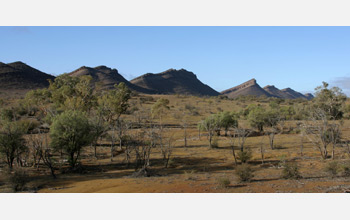
Below a cliff, a reddish bed is one of many stromatolite bioherms containing fossil sponges.
Credit: Adam Maloof
Download the high-resolution JPG version of the image. (2.1 MB)
Use your mouse to right-click (Mac users may need to Ctrl-click) the link above and choose the option that will save the file or target to your computer.
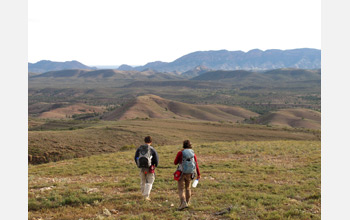
Researchers Laura Poppick and Blake Dyer hike down a stromatolite reef in South Australia.
Credit: Adam Maloof
Download the high-resolution JPG version of the image. (5.6 MB)
Use your mouse to right-click (Mac users may need to Ctrl-click) the link above and choose the option that will save the file or target to your computer.
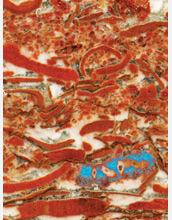
Image of limestone rock containing fossils; fossil of interest is highlighted in blue using automated image tracing software. The serial grinding process created nearly 500 such images that the scientists stacked and autotraced to create a 3-D model.
Credit: Maloof Lab/Situ Studio
Download the high-resolution JPG version of the image. (5.8 MB)
Use your mouse to right-click (Mac users may need to Ctrl-click) the link above and choose the option that will save the file or target to your computer.
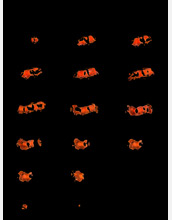
Red autotraced forms from 15 slices through rock; the shape of a single fossil changes.
Credit: Situ Studio
Download the high-resolution JPG version of the image. (1.6 MB)
Use your mouse to right-click (Mac users may need to Ctrl-click) the link above and choose the option that will save the file or target to your computer.
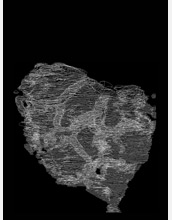
Stacking autotraced rock sections results in this image; the elliptical fossil is clearly visible.
Credit: Situ Studio
Download the high-resolution JPG version of the image. (3 MB)
Use your mouse to right-click (Mac users may need to Ctrl-click) the link above and choose the option that will save the file or target to your computer.
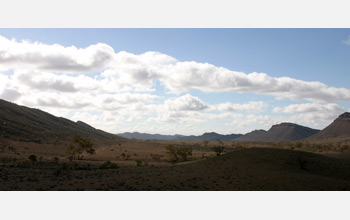
The stratigraphic section where the fossil sponges were discovered may be seen in this image.
Credit: Adam Maloof
Download the high-resolution JPG version of the image. (1.9 MB)
Use your mouse to right-click (Mac users may need to Ctrl-click) the link above and choose the option that will save the file or target to your computer.
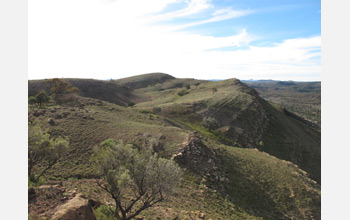
View of the Trezona Formation in the West Central Flinders Ranges, South Australia.
Credit: Adam Maloof
Download the high-resolution JPG version of the image. (2.9 MB)
Use your mouse to right-click (Mac users may need to Ctrl-click) the link above and choose the option that will save the file or target to your computer.