|

Frontiers
Witches' Brew of Weird Bugs

October 1996
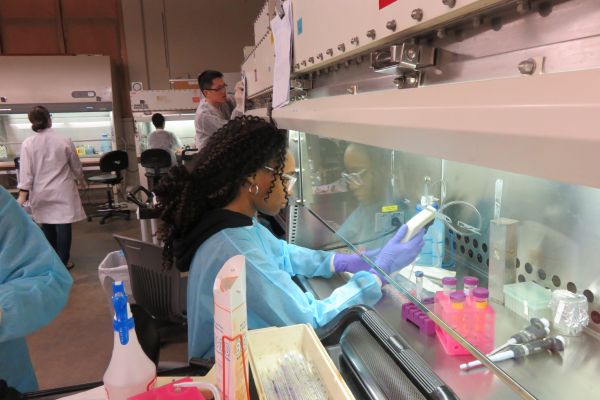
"A bubbling cauldron" is how one might describe
microbiologist John Battista's lab at Louisiana State University in Baton
Rouge. Here he studies pink microbes with a smell reminiscent of rotten
cabbage. These "weird bugs," as he calls them, have one very important
quality worth studying: they can withstand radiation 3,000 times what
it would take to kill a human.
Deinococcus radiodurans, or "strange berry that withstands
radiation," is the subject of Battista's NSF-supported research on
how a life form can survive massive doses of radiation. When exposed
to 1.5 million rads of ionizing radiation, Deinococcus repaired
the damage to its shattered DNA in a matter of hours.
"There's no apparent reason for such high radiation protection on
earth," says Phil Harriman, Program Director in NSF's Genetics and
Nucleic Acids Program, which funds Battista's research. The rare bacterium
was discovered in 1956 during experiments in which packaged food was
sterilized using radiation instead of heat.
Battista has identified several aspects of the microbe's radiation-repair
mechanism. It has from four to ten DNA molecules compared to only one
for most other bacteria. A protein, called RecA, matches the shattered
pieces of DNA and splices them back together. During these repairs,
cell-building activities are shut off and the broken DNA pieces are
kept in place.
Deinococcus is believed to be some two billion years old,
perhaps one of the earliest life forms on the planet. One theory
suggests that it may originally have come from outer space, perhaps
hitching a ride on an interplanetary traveler, a chunk of rock or
ice. Battista¹s work suggests otherwise.
"That journey would subject the organism to tremendous temperature
extremes, and Deinococcus does not tolerate heat at all," says
Battista. "We can inactivate it at temperatures as low as 45 degrees
Centigrade. It seems unlikely that this bug could survive a trip
through interstellar space and our atmosphere."
Battista thinks the microbe's ability to withstand radiation is
related to how it survives long periods of dehydration. His work
on different strains has shown correlations between resistance to
radiation and resistance to dehydration.
"Cellular damage caused by dehydration and radiation are very similar," he
explains. "Both cause breaks in DNA strands." Deinococcus has
survived as many as 200 of these breaks to reemerge intact from
the "bubbling cauldron" in Baton Rouge.

|