




The Office of Legislative and Public Affairs is the principal point of contact between Congress and the U.S. National Science Foundation.
The office's congressional team:
- Coordinates requests for information.
- Coordinates NSF officials' appearances at congressional hearings.
- Ensures timely responses to congressionally mandated reports and correspondence.
- Arranges meetings with Members of Congress and their staff.
- Arranges site visits to NSF-supported facilities.
Events
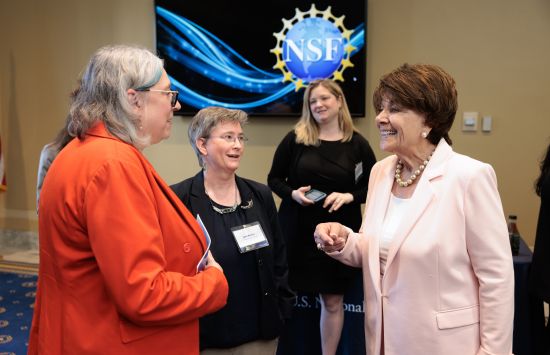
NSF regularly hosts all-interested congressional staff briefings to highlight the breadth and impact of NSF investments in science and engineering and the STEM workforce of today and tomorrow.
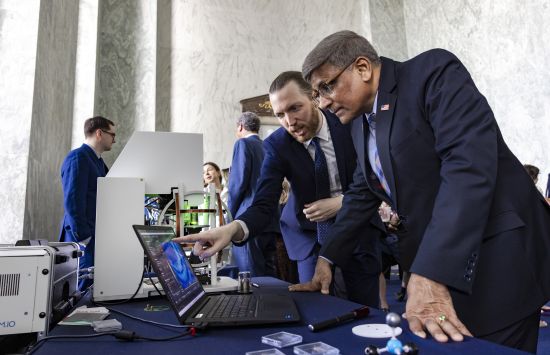
National Artificial Intelligence Research Resource Demo
May 22, 2024
Sponsored by the House Artificial Intelligence Caucus
Along with the Department of Energy, NASA and the National Institutes of Health, NSF provided hands-on demonstrations of the kind of groundbreaking AI innovation that is being made possible through the NAIRR Pilot and could be fueled through a fully realized NAIRR.
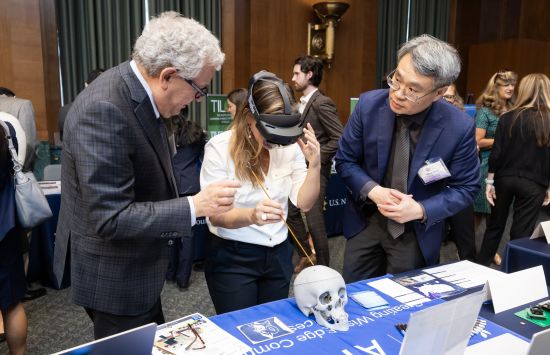
NSF Quantum Research Showcase
April 30, 2024
Sponsored by the House Committee on Science, Space and Technology
This event brought 37 researchers, students and educators from around the country to discuss ongoing research, education and workforce initiatives through demonstrations and prototypes.
NSF Artificial Intelligence Research Institutes Showcase
Sept. 19, 2023
Sponsored by the Senate AI Caucus
Joined by federal and industry partners, NSF celebrated and shared the work of its 25 National AI Research Institutes.
About NSF
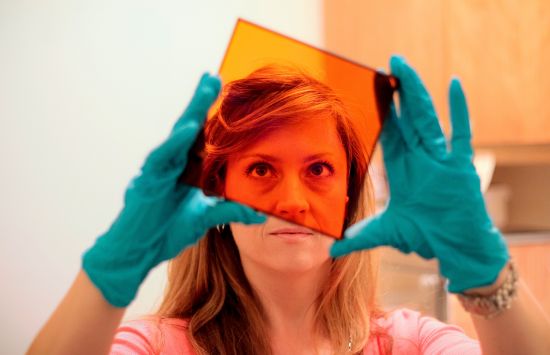
Agency overview
Since 1950, NSF has supported science and engineering in all 50 states and U.S. territories.
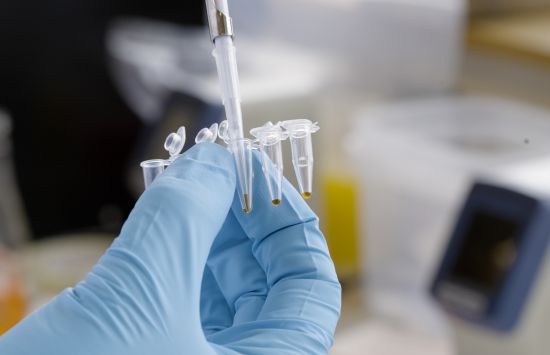
Impacts
Since 1950, NSF has invested in ideas and innovations that have shaped the modern world.
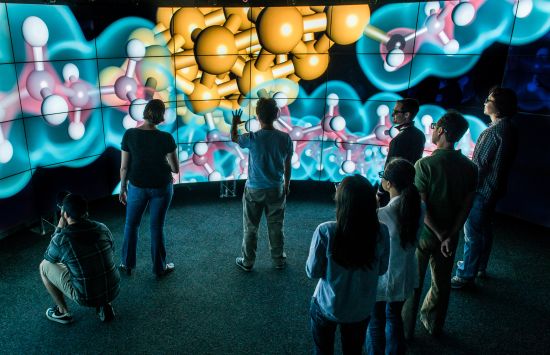
Focus areas
NSF accelerates new technologies and big ideas — from biology to emerging technologies.

'CHIPS and Science' and NSF
The "CHIPS and Science Act of 2022" investments in NSF will help the United States remain a global leader in innovation.

Fiscal Year 2027 Budget Request
NSF in your state
State fact sheets
These brief summaries include the total amount of awards to institutions within a state, some of the state's institutions receiving the awards and examples of projects currently funded in the state.
Award Abstracts Database
View information about research projects that NSF has funded since 1989, including abstracts that describe the research and names of principal investigators and their institutions. The database includes both completed and in-process research.
NSF by the Numbers
This dashboard provides statistical and funding information for awards funded, institutions funded, funding rates, proposals evaluated and award obligations by Fiscal Year.
Hearings: Testimonies and summaries
119th Congress (2025–26)
Date: Thursday, January 22, 2026
Time: 10:00 a.m.
Location: 2318 Rayburn House Office Building
Hearing: Assessing U.S. Leadership in Quantum Science and Technology
Committee: House Committee on Science, Space, and Technology
Witnesses: Dr. Saul Gonzalez, Deputy Directorate Head, Directorate for Mathematical and Physical Sciences, NSF; Dr. James Kushmerick, Director, Physical Measurement Laboratory, National Institute of Standards and Technology; Dr. Mark Clampin, Deputy Associate Administrator, Science Mission Directorate, National Aeronautics and Space Administration; Dr. Tanner Crowder, Quantum Information Science Lead, Office of Science, Department of Energy
Webcast: https://science.house.gov/hearings?ID=C650AC9A-BD9F-47F2-AADE-96396A868963
Date: Thursday, December 18, 2025
Time: 10:00 a.m.
Location: 2318 Rayburn House Office Building
Hearing: Research Security: Examining the Implementation of the CHIPS and Science Act and NSPM-33
Committee: House Committee on Science, Space, and Technology, Subcommittee on Investigations and Oversight
Witnesses: Dr. Rebecca Keiser, Chief of Research Security, Strategy, and Policy & Acting Chief of Staff, NSF; Dr. Daniel Evans, Assistant Deputy Associate Administrator for Research, National Aeronautics and Space Administration; Dr. Patricia Valdez, Chief Extramural Research Integrity Officer, National Institutes of Health; Mr. Jay Tilden, Director of Office of Intelligence and Counterintelligence, U.S. Department of Energy
Webcast: https://science.house.gov/2025/12/subcommittee-hearing
Date: Wednesday, February 12, 2025
Time: 10:00 a.m.
Location: 253 Senate Russell Office Building
Hearing: Nuuk and Cranny: Looking at the Arctic and Greenland’s Geostrategic Importance to U.S. Interests
Committee: Senate Committee on Commerce, Science, and Transportation
Witnesses: Dr. Jennifer Mercer, Section Head for the Arctic Sciences Section at the Office of Polar Programs, NSF; Mr. Alexander Gray, Senior Fellow in National Security Affairs, American Foreign Policy Council; Mr. Anthony Marchese, Chairman, Texas Mineral Resources; Dr. Rebecca Pincus, Director of Polar Institute, Wilson Center
Webcast: https://www.commerce.senate.gov/2025/2/nuuk-and-cranny-looking-at-the-arctic-and-greenland-s-geostrategic-importance-to-u-s-interests_2
118th Congress (2023–24)
Date: Thursday, May 23, 2024.
Time: 9:30 a.m.
Location: Dirksen Senate Office Building 192.
Hearing: A Review of the President's Fiscal Year 2025 Budget Request for the National Aeronautics and Space Administration and for the National Science Foundation.
Committee: Senate Committee on Appropriations; Subcommittee on Commerce, Justice, Science, and Related Agencies.
Witnesses: The Honorable Sethuraman Panchanathan (PDF, 194.33 KB), Director, NSF; The Honorable Bill Nelson, Administrator, NASA.
Webcast: https://www.appropriations.senate.gov/hearings/a-review-of-the-presidents-fiscal-year-2025-budget-request-for-the-national-aeronautics-and-space-administration-and-for-the-national-science-foundation.
Date: Thursday, May 16, 2024.
Time: 10:00 a.m.
Location: 2318 Rayburn House Office Building.
Hearing: Oversight and Examination of the National Science Foundation's Priorities for 2025 and Beyond.
Committee: House Committee on Science, Space, and Technology; Subcommittee on Research and Technology.
Witnesses: The Honorable Sethuraman Panchanathan (PDF, 194.28 KB) , director, NSF; Dan Reed, former Chair, National Science Board.
Webcast: https://science.house.gov/2024/5/research-and-technology-subcommittee-hearing-oversight-and-examination-of-the-national-science-foundation-s-priorities-for-2025-and-beyond.
Date: Thursday, Feb. 15, 2024.
Time: 10:00 a.m.
Location: 2318 Rayburn House Office Building.
Hearing: Examining Federal Science Agency Actions to Secure the U.S. Science and Technology Enterprise.
Committee: House Committee on Science, Space, and Technology.
Witnesses: Rebecca Keiser (PDF, 260.02 KB) , Chief of Research Security Strategy and Policy, NSF; The Honorable Arati Prabhakar, Director, White House Office of Science and Technology Policy; The Honorable Geri Richmond, Under Secretary for Science and Innovation, Department of Energy; Dr. Michael Lauer, Deputy Director for Extramural Research, National Institutes of Health.
Webcast: https://science.house.gov/2024/2/full-committee-hearing-examining-federal-science-agency-actions-to-secure-the-u-s-science-and-technology-enterprise.
Date: Tuesday, Feb. 6, 2024.
Time: 10:00 a.m.
Location: 2318 Rayburn House Office Building.
Hearing: Federal Science Agencies and the Promise of AI in Driving Scientific Discoveries
Committee: House Committee on Science, Space, and Technology; Subcommittee on Research and Technology; Subcommittee on Energy.
Witnesses: Tess DeBlanc Knowles (PDF, 197.84 KB) , Special Assistant to the Director for Artificial Intelligence, NSF; Georgia Tourassi, Associate Laboratory Director, Computing and Computational Sciences, Oak Ridge National Laboratory; Chaouki Abdallah, Executive Vice President for Research, Georgia Institute of Technology; Louay Chamra, Dean, School of Engineering and Computer Science, Oakland University; Jack Clark, co-Founder and Head of Policy, Anthropic.
Webcast: https://science.house.gov/2024/2/joint-research-technology-and-energy-subcommittee-hearing-federal-science-agencies-and-the-promise-of-ai-in-driving-scientific-discoveries.
Date: Tuesday, Jan. 30, 2024.
Time: 2:00 p.m.
Location: 2318 Rayburn House Office Building.
Hearing: From Risk to Resilience: Reauthorizing the Earthquake and Windstorm Hazards Reduction Programs.
Committee: House Committee on Science, Space, and Technology; Subcommittee on Research and Technology.
Witnesses: Susan Margulies (PDF, 211.17 KB) , Assistant Director for Engineering, NSF; Jason Averill, Deputy Director of the Engineering Laboratory, National Institute of Standards and Technology; Edward Laatsch, Director, Safety, Planning, and Building Science Division, Risk Analysis, Planning and Information Directorate, Federal Emergency Management Agency; Gavin Hayes, Earthquake Hazards Program Coordinator, U.S. Geological Survey.
Webcast: https://science.house.gov/2024/1/research-and-technology-subcommittee-hearing-from-risk-to-resilience-reauthorizing-the-earthquake-and-windstorm-hazards-reduction-programs.
Date: Wednesday, Oct. 4, 2023.
Time: 2:00 p.m.
Location: Russell Senate Office Building 253.
Hearing: CHIPS and Science Implementation and Oversight.
Committee: Senate Committee on Commerce, Science, and Transportation.
Witnesses: The Honorable Sethuraman Panchanathan (PDF, 238.93 KB) , Director, NSF; The Honorable Gina Raimondo, Secretary, U.S. Department of Commerce.
Webcast: https://www.commerce.senate.gov/2023/10/chips-and-science-implementation-and-oversight.
Date: Thursday, Sept. 14, 2023.
Time: 10:00 a.m.
Location: 2154 Rayburn House Office Building.
Hearing: Oversight of Federal Agencies' Post-Pandemic Telework Policies.
Committee: House Committee on Oversight and Accountability; Subcommittee on Government Operations and the Federal Workforce.
Witnesses: Karen Marrongelle (PDF, 144.88 KB) , Chief Operating Officer, NSF; Robert Gibbs, Associate Administrator for the Mission Support Directorate, NASA; Dan Dorman, Executive Director for Operation, Nuclear Regulatory Commission; Randolph "Tex" Alles, Deputy Under Secretary for Management and Senior Official Performing the Duties of the Under Secretary for Management, Department of Homeland Security.
Webcast: https://oversight.house.gov/hearing/oversight-of-federal-agencies-post-pandemic-telework-policies/.
Date: Wednesday, April 26, 2023.
Time: 10:00 a.m.
Location: 2318 Rayburn House Office Building.
Hearing: An Overview of the National Science Foundation Budget Proposal for Fiscal Year 2024.
Committee: House Committee on Science, Space, and Technology.
Witnesses: The Honorable Sethuraman Panchanathan (PDF, 253.3 KB) , Director, NSF; Dan Reed, Chair, National Science Board.
Webcast: https://science.house.gov/2023/4/full-committee-hearing-an-overview-of-the-national-science-foundation-budget-proposal-for-fiscal-year-2024.
Date: Wednesday, April 19, 2023.
Time: 9:30 a.m.
Location: H-309, the Capitol.
Hearing: Fiscal Year 2024 Request for The National Science Foundation.
Committee: House Committee on Appropriations; Subcommittee on Commerce, Justice, Science, and Related Agencies.
Witnesses: The Honorable Sethuraman Panchanathan (PDF, 254.36 KB) , Director, NSF.
Webcast: https://democrats-appropriations.house.gov/events/hearings/budget-hearing-fiscal-year-2024-request-for-the-national-science-foundation
Date: Tuesday, April 18, 2023.
Time: 2:30 p.m.
Location: Dirksen Senate Office Building 192.
Hearing: A Review of the President's Fiscal Year 2024 Funding Request for the National Aeronautics and Space Administration and for the National Science Foundation.
Committee: Senate Committee on Appropriations; Subcommittee on Commerce, Justice, Science, and Related Agencies.
Witnesses: The Honorable Sethuraman Panchanathan (PDF, 254.45 KB) , Director, NSF; The Honorable Bill Nelson, Administrator, NASA.
Webcast: https://www.appropriations.senate.gov/hearings/a-review-of-the-presidents-fiscal-year-2024-funding-request-for-the-national-aeronautics-and-space-administration-and-for-the-national-science-foundation.
Date: Wednesday, March 8, 2023.
Time: 10:00 a.m.
Location: 2318 Rayburn House Office Building.
Hearing: Innovation Through Collaboration: The Department of Energy's Role in the U.S. Research Ecosystem.
Committee: House Committee on Science, Space, and Technology.
Witnesses: Sean L. Jones (PDF, 187.76 KB) , Assistant Director, Directorate for Mathematical and Physical Sciences, NSF; Harriet Kung, Deputy Director for Science Programs in the Office of Science, the U.S. Department of Energy; James L. Reuter, Associate Administrator for the Space Technology Mission Directorate, NASA; Michael C. Morgan, Assistant Secretary of Commerce for Environmental Observation and Prediction, the National Oceanic and Atmospheric Administration.
Webcast: https://science.house.gov/2023/3/full-committee-hearing.
117th Congress (2021–22)
Date: Tuesday, Dec. 6, 2022.
Time: 1:00 p.m.
Location: Online via videoconferencing and 2318 Rayburn House Office Building.
Hearing: Building a Safer Antarctic Research Environment.
Committee: House Committee on Science, Space, and Technology; Subcommittee on Research and Technology.
Witnesses: Karen Marrongelle, Chief Operating Officer, National Science Foundation; Kathleen Naeher, Chief Operating Officer of the Civil Group, Leidos; Angela V. Olinto, Dean of the Physical Sciences Division and Albert A. Michelson Distinguished Service Professor, University of Chicago; Anne Kelly, Deputy Director, The Nature Conservancy Alaska Chapter.
Webcast: https://science.house.gov/hearings/building-a-safer-antarctic-research-environment.
Additional resources: Learn about steps NSF is taking to prevent sexual assault and harassment.
Date: Wednesday, May 11, 2022.
Time: 2:00 p.m.
Location: Online via videoconferencing.
Hearing: Fiscal Year 2023 Budget Request for the National Science Foundation.
Witnesses: The Honorable Sethuraman Panchanathan (PDF, 205.76 KB) , Director, NSF.
Webcast: https://appropriations.house.gov/events/hearings/fiscal-year-2023-budget-request-national-science-foundation
Date: Tuesday, May 3, 2022.
Time: 10:00 a.m.
Location: Dirksen Senate Office Building SD-192.
Hearing: A Review of the President's Fiscal Year 2023 Funding Request for the National Aeronautics and Space Administration and the National Science Foundation.
Witnesses: The Honorable Sethuraman Panchanathan (PDF, 210.4 KB) , Director, NSF; The Honorable Bill Nelson, Administrator, NASA.
Webcast: https://www.appropriations.senate.gov/hearings/a-review-of-the-presidents-fiscal-year-2023-funding-request-for-the-national-aeronautics-and-space-administration-and-the-national-science-foundation.
Date: Wednesday, April 6, 2022.
Time: 10:00 a.m.
Location: Online via videoconferencing and 2318 Rayburn House Office Building.
Hearing: SBIR Turns 40: Evaluating Support for Small Business Innovation.
Committee: House Committee on Science, Space, and Technology; Subcommittee on Research and Technology.
Witnesses: Ben Schrag (PDF, 270.76 KB) , SBIR/STTR Program Director and Policy Liaison, Directorate for Technology, Innovation, and Partnerships, NSF.
Webcast: https://science.house.gov/hearings?ID=B757DFF9-8EC0-4054-8598-4B54460D2E02.
Date: Wednesday, Nov. 10, 2021.
Time: 10:00 a.m.
Location: Online via videoconferencing.
Hearing: Weathering the Storm: Reauthorizing the National Wind Impact Reduction Program.
Committee: House Committee on Science, Space, and Technology; Subcommittee on Research and Technology.
Witnesses: Linda Blevins (PDF, 253.58 KB) , Deputy Assistant Director, Directorate for Engineering, NSF.
Webcast: https://science.house.gov/hearings?ID=6B4DE5E0-7CEB-44FB-A692-E8BF5DA09620.
Date: Wednesday, April 28, 2021.
Time: 10:00 a.m.
Location: Online via videoconferencing.
Hearing: National Science Foundation: Advancing Research for the Future of U.S. Innovation.
Committee: House Committee on Science, Space, and Technology; Subcommittee on Research and Technology.
Witnesses: The Honorable Sethuraman Panchanathan, Director, NSF; Ellen Ochoa, Chair, National Science Board.
Webcast: https://science.house.gov/hearings?ID=AA1DF3D1-B4A3-4DD9-B5AC-B91DFC714AB5
Date: Wednesday, April 14, 2021.
Time: 10:00 a.m.
Location: Online via videoconferencing.
Hearing: The National Science Foundation's Fiscal Year 2022 Budget Request.
Committee: House Committee on Appropriations; Subcommittee on Commerce, Justice, Science, and Related Agencies.
Witnesses: The Honorable Sethuraman Panchanathan, Director, NSF.
Webcast: https://appropriations.house.gov/events/hearings/national-science-foundations-fiscal-year-2022-budget-request.
Date: Tuesday, April 13, 2021.
Time: 2:00 p.m.
Location: Dirksen Senate Office Building SD-106.
Hearing: A Review of the President's Fiscal Year 2022 Funding Request for the National Science Foundation and Securing U.S. Competitiveness.
Committee: Senate Committee on Appropriations; Subcommittee on Commerce, Justice, Science, and Related Agencies.
Witnesses: The Honorable Sethuraman Panchanathan, Director, NSF.
Webcast: https://www.appropriations.senate.gov/a-review-of-the-presidents-fiscal-year-2022-funding-request-for-the-national-science-foundation-and-securing-us-competitiveness.
116th Congress (2019–20)
Date: Wednesday, Feb. 5, 2020.
Time: 4:00 p.m.
Location: 2318 Rayburn House Office Building.
Hearing: America's Seed Fund: A Review of SBIR and STTR.
Committee: House Committee on Science, Space, and Technology; Subcommittee on Research and Technology.
Witnesses: Dawn Tilbury, Assistant Director, Directorate of Engineering; National Science Foundation; Maryann Feldman, S.K. Heninger Distinguished Professor of Public Policy, Department of Public Policy; Adjunct Professor of Finance, Kenan-Flagler Business School; Faculty Director, CREATE, Kenan Institute of Private Enterprise; The University of North Carolina at Chapel Hill; Nicholas Cucinelli, Chief Executive Officer, Endectra LLC; Johnny Park, Chief Executive Officer, Wabash Heartland Innovation Network.
Webcast: https://science.house.gov/hearings?ID=A94F8D23-36C8-4EFC-87BB-9FA629AA8306.
Date: Wednesday, Jan. 15, 2020.
Time: 10:00 a.m.
Location: 216 Hart Senate Office Building.
Hearing: Industries of the Future.
Committee: Senate Committee on Commerce, Science, and Transportation.
Witnesses: The Honorable Walter Copan, Director, National Institute of Standards and Technology, Department of Commerce; Under Secretary of Commerce for Standards and Technology; The Honorable France Córdova, Director, NSF; The Honorable Michael Kratsios, Chief Technology Officer of the United States, Office of Science and Technology Policy; The Honorable Michael O'Rielly, Commissioner, Federal Communications Commission; The Honorable Jessica Rosenworcel, Commissioner, Federal Communications Commission.
Webcast: https://www.commerce.senate.gov/2020/1/industries-of-the-future.
Date: Tuesday, Nov. 19, 2019.
Time: 10:00 a.m.
Location: 342 Dirksen Senate Office Building.
Hearing: Securing the U.S. Research Enterprise from China's Talent Recruitment Plans.
Committee: Senate Committee on Homeland Security and Governmental Affairs; Permanent Subcommittee on Investigations.
Witnesses: John Brown, Assistant Director, Counterintelligence Division, FBI, U.S. Department of Justice; Rebecca L. Keiser, Head, Office of International Science and Engineering, NSF; Dr. Michael S. Lauer, Deputy Director for Extramural Research, National Institutes of Health, U.S. Department of Health and Human Services; The Honorable Christopher Fall, Director, Office of Science, U.S. Department of Energy; Edward J. Ramotowski, Deputy Assistant Secretary for Visa Services, Bureau of Consular Affairs, U.S. Department of State.
Webcast: https://www.hsgac.senate.gov/subcommittees/investigations/hearings/securing-the-us-research-enterprise-from-chinas-talent-recruitment-plans.
Date: Tuesday, Sept. 24, 2019.
Time: 4:00 p.m.
Location: 2318 Rayburn House Office Building.
Hearing: Artificial Intelligence and the Future of Work.
Committee: House Committee on Science, Space, and Technology; Subcommittee on Research and Technology.
Witnesses: Arthur Lupia, Assistant Director, Directorate for Social, Behavioral and Economic Sciences, NSF; Erik Brynjolfsson, Schussel Family Professor of Management Science and Director, The MIT Initiative on the Digital Economy, Massachusetts Institute of Technology; Rebekah Kowalski, Vice President, Manufacturing Services, ManpowerGroup; Sue Ellspermann, President, Ivy Tech Community College.
Webcast: https://science.house.gov/hearings?ID=8F55D718-BA71-4771-A28F-903B3F168498.
Date: Sept. 19, 2019.
Time: 10:00 a.m.
Location: H-309 Capitol.
Hearing: Science, Technology, Engineering, and Mathematics (STEM) Engagement.
Committee: House Committee on Appropriations; Subcommittee on Commerce, Science, Justice, and Related Agencies.
Witnesses: Michael Kincaid, Associate Administrator for STEM Engagement, NASA; Karen Marrongelle, Assistant Director for Education and Human Resources, NSF.
Webcast: https://www.congress.gov/event/116th-congress/house-event/109933
Date: Thursday, May 16, 2019.
Time: 10:00 a.m.
Location: 2318 Rayburn House Office Building.
Hearing: Event Horizon Telescope: The Black Hole Seen Round The World.
Committee: House Committee on Science, Space and Technology; Subcommittee on Research and Technology.
Witnesses: France Córdova, Director, NSF; Sheperd Doeleman, Director, Event Horizon Telescope; Center for Astrophysics, Harvard and Smithsonian; Colin Lonsdale, Director, MIT Haystack Observatory; Katherine Bouman, Postdoctoral Fellow, Center for Astrophysics, Harvard and Smithsonian.
Webcast: https://science.house.gov/hearings?ID=4790768C-C620-498C-A2C7-C372B101426C.
Date: Wednesday, May 8, 2019.
Time: 10:00 a.m.
Location: 2318 Rayburn House Office Building.
Hearing: A Review of the National Science Foundation FY 2020 Budget Request.
Committee: House Committee on Science, Space, and Technology; Subcommittee on Research and Technology.
Witnesses: France Córdova, Director, NSF; Diane Souvaine, Chair, National Science Board.
Webcast: https://science.house.gov/hearings?ID=CB747AB9-2DA7-4C66-8003-91FA0944387B.
Date: Tuesday, March 26, 2019.
Time: 9:30 a.m.
Location: H-309 Capitol.
Hearing: National Science Foundation's Budget Request for Fiscal Year 2020.
Committee: House Committee on Appropriations; Subcommittee on Commerce, Justice, Science, and Related Agencies.
Witness: France Córdova, Director, NSF.
Webcast: https://democrats-appropriations.house.gov/legislation/hearings/national-science-foundation-s-budget-request-for-fiscal-year-2020.
Additional resources
Budget, performance and financial reporting
Learn how NSF works to ensure funds are used effectively to support the agency's mission and strategic goals.
COVID-19 funding updates
View NSF's funding reports for the "American Rescue Plan Act of 2021" and the "Coronavirus Aid, Relief and Economic Security Act."
Academic technology transfer and commercialization
View a list of webpages describing the technology transfer and commercialization efforts at institutions of higher education.
Responses to congressional wastebooks
View NSF's responses to congressional wastebook reports.
Contact us
Email: Congressionalteam@nsf.gov
Phone: 703-292-8070